
Google has released its first major update of 2026, and it is focused only on Google Discover. Google is calling it the February 2026 Discover core update.
The update will roll out gradually over the next two weeks. At the moment, it applies only to English-language users in the United States, but Google says it will later expand to other countries and languages.
Google explained that this update is meant to improve how articles are selected and shown in Discover. According to Google, the update is designed to bring better quality content to users.
With this change, Google says Discover will:
- Show more content from websites based in the user’s own country
- Reduce clickbait and overly dramatic content
- Highlight content that is original, detailed, timely, and created by knowledgeable sources
Because Discover will now focus more on local content, some non-US websites that target readers in the US may see a drop in traffic. However, over time, those same websites are expected to gain more visibility within their own local regions.
While Google has often said that regular core updates can affect Discover, it is unusual for Google to announce an update that is specifically limited to Discover only. This makes the February 2026 update stand out.
It also explains why many publishers have noticed sudden changes in their Discover visibility over the past few days, with a large number of reports and discussions appearing online. Here are some select comments from this post:
“It feels like Google is ‘fixing’ the SERPs by serving more low-intent or Discover-style traffic that doesn’t convert.”
“I remain at 90-95% down, wiped from search, images, news, and discover.”
“I’ve been doing this for a long time, but it was all wiped overnight, and yes, my site was in News, just like Discover and removed.”
“Not trying sound negative or anything, but my site did start showing up again on Discover and on the first page of Google News…”
Those are just some of the comments I pulled from this site. John Mueller from Google added:
“Since many sites demonstrate deep knowledge across a wide range of subjects, our systems are designed to identify expertise on a topic-by-topic basis. So whether a site has expertise in multiple areas or has a deep focus on a single topic, there’s equal opportunity to show up in Discover. For example, a local news site with a dedicated gardening section could have established expertise in gardening, even though it covers other topics. In contrast, a movie review site that wrote a single article about gardening would likely not.
We’ll continue to show content that’s personalized based on people’s creator and source preferences.
As with all core updates, this change may lead to fluctuations in Discover traffic. Some sites might see increases or decreases; many sites may see no change at all. We’re releasing this update to English language users in the US, and will expand it to all countries and languages in the months ahead.”
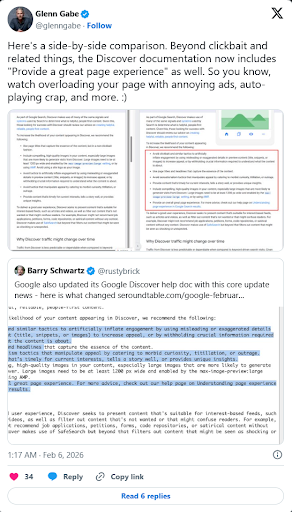
Google has updated its Discover guidelines, explaining how publishers can improve their chances of appearing in Discover.
According to Google, content is more likely to perform well in Discover when publishers:
- Avoid misleading or exaggerated headlines, images, or summaries that are designed only to attract clicks
- Use clear and accurate titles that reflect what the content is actually about
- Stay away from overly dramatic or shocking content meant to provoke curiosity or outrage
- Create content that is timely, well-told, and offers something new or useful to readers
- Use strong, high-quality images, especially large images that are at least 1200 pixels wide and properly enabled
- Ensure the page provides a smooth and positive experience for users, including fast loading and easy reading
Google emphasizes that Discover works best when content is helpful, honest, and engaging, rather than attention-seeking or misleading.
The rollout of this update is expected to take up to two weeks, and for now, it applies only to English-language users in the United States. Google has not specified when it will expand to other countries or languages.