
Google’s Gary Illyes said that website owners may be better off leaving out the lastmod date from their XML Sitemap if the dates are incorrect.
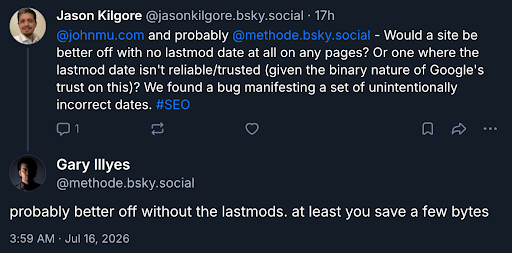
In response to a question from Jason Kilgore, Illyes said that it is “probably better off without the lastmods” when the dates are inaccurate.
The main point is simple: if you cannot keep your lastmod dates accurate, it may be better not to include them at all.
‘’Would a site be better off with no lastmod date at all on any pages? Or one where the lastmod date isn’t reliable/trusted (given the binary nature of Google’s trust on this)? We found a bug manifesting a set of unintentionally incorrect dates. ‘’
This is not new advice from Google. Google has previously explained that it may choose to trust or ignore the lastmod date in an XML Sitemap based on how accurately a website uses it.
The date should only be updated when there has been a significant change to the page or genuinely new content has been added. It should not be changed simply because of copyright updates or minor edits.
Google has also warned against updating the lastmod date too frequently. In the past, Google even said it largely ignored these dates, although its guidance later changed.
The key takeaway is that changing the lastmod date is not an SEO shortcut. It should accurately reflect meaningful updates to the page.
Here are the recent posts covering this topic:
In short, use the lastmod date correctly and don’t try to trick Google.
Forum discussion at Bluesky.